April 7, 2016

Participation Tracking

Recently, I have begun using a small group tool that might sound a little crazy while at the same time completely uninteresting. I've dubbed it my "Participation Tracker" Read on for my story and for my reasons why I think you should try this, too. 

Why did I start tracking participation?

So the first thing I have to say, is this: This Participation Tracker thing wasn't really my idea at all. I began piloting a program called "Jacob's Ladder" with my highest readers (those falling in the 90th percentile with their Reading MAP scores). One thing our principal wanted us to do was to keep track of how each student was participating in the higher order discussion work she envisioned happening around this group. She thought maybe we could make little checks by students' names or something so we could compare their participation to their score growth. Initially, I thought, "That is crazy. And silly. Nope. I do not have time for that. I am not going to do it.I'm just going to focus on what this program says to do. Again, No."

So what made me start it?

I decided to change my mind about that when it began to dawn on me that some of my highest performers were also the least likely to take part in the discussion and sharing. Getting them to add their ideas to our discussion or respond to others who were talking was like pulling teeth. And I began to realize that this was happening frequently. And by frequently I mean almost every day. I thought. I didn't actually know since I was simply relying on my memory for it. And why weren't they participating? We were having deep and challenging discussions! Furthermore, they had good things to say (according to their written work)! So, I decided to put a quick little table together to see if there actually was a problem like I thought.

Why am I still using it?

Ok, I have a few big reasons:
  1. It helps me be more fair with my attention. With a brief glance at my checklist, I can see who I've given attention to (whether they have asked for it or not), and who still needs to be invited to participate. Then, I can work to purposefully invite them into the discussion. 
  2. It has been super motivating for many kids. They know I'm giving them a check or a tally, and they know how to get it. (But don't forget to get some "baseline" data when they DON'T know you are using it as well.)
  3. It gives me real data to start a conversation with students who struggle to participate. You can't argue with the data! And yes, at this point, I am showing them the whole class spreadsheet. I feel like it is effective for the struggling student to "see" himself in the context of the whole class and the whole learning conversation. 
  4. It also has given me real data to start a conversation with one student in particular who thrives off of attention and participation, but on the other hand falls apart when I don't call on him every time he has something to say. I'm able to show him how he has been called on more than others and that he needs to let others speak. Again, he can "see" himself in the context of the whole class.


Does it have potential for other areas? 

Of course! One week, I printed off the whole class roster and challenged each kid to participate in whole group Math discussions at least twice during the week. I planned the goal  number based on the opportunities I knew students would get that week to be one voice of many during whole group instruction.

I would encourage teachers at any level to try some form of Participation Tracking out-even if it's just for the day. Challenge yourself! Challenge your kids!

Here is a link to the tracker shown above. It's available to you to edit and use as you need:

Click For the Free File!


April 5, 2016

Fraction Fun

I love teaching Math, and teaching fractions is one of my favorite parts of teaching Math! I tried two new things this year and I want to share them with you. Despite the fact that I am in my eighth year of teaching 2nd grade, I am constantly trying to find new things, as I know many of you do as well!


Fraction Play Dough


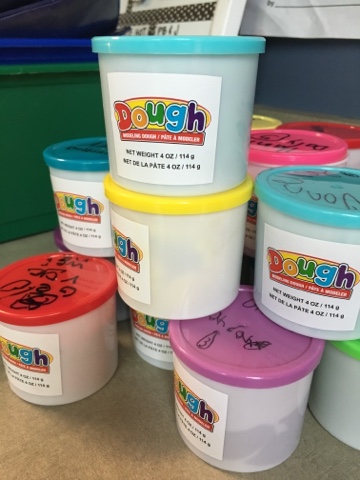
First, I bought everyone their own can of Play Dough from the Dollar Tree. They come in packs of 4, and they had all kinds of colors. The kids enjoyed "claiming" their own can and picking out their own color to work with. 


I opened our study on fractions by telling my students to divide their dough into two pieces. They all tried to find different ways to do this, because they are very into coming up with ideas that others may not have this year! See the list below for ideas that came up as we explored fractions with play dough. I honestly didn't plan all of these ahead of time, but it really evolved!

-Guide students to show different divisions of the play dough. As you guide students through this, create an anchor chart showing drawings of the play dough balls: unequal parts, equal parts, halves, thirds, fourths.
-Discuss wholes: When students show halves, thirds, or fourths, connect back to the idea that 2/2 = One whole, 3/3 = One whole, and so on.
-Keep going with the above idea, and introduce some addition sentences 1/3 + 1/3 + 1/3 = 3/3 = One Whole
-Discuss how students' parts are the same or different. Some of my kids flattened their play dough before dividing, some kept it in a ball. The shapes were different, but the fractions remained the same.


Pattern Shapes App


In my small group, we used our new iPads for the first time! This app is called Pattern Shapes. Clarity Innovations has some great apps for Math tools! I am really loving them. But back to the point. Here are the two things we did to connect our work with pattern blocks to fractions:

-I guided students to "cover" a yellow "cupcake" with different colors of icing. Then, we named the parts and paid special attention to how many parts it took to cover the cupcake.
-After doing this, I assigned students to use these equivalent fractions to create a picture that was "Half Yellow". I found this idea in my new favorite blog, E is for Explore. Some students stuck to just maintaining equality with the basic equivalent fractions. So, every time they added a blue rhombus, they pulled out three blue rhombi and one yellow hexagon. More advanced students explored the idea that doing something like using 1 red trapezoid, 1 rhombus, and 1 triangle would also balance out a yellow hexagon.

Have fun teaching fractions!

April 3, 2016

April Pinterest Linky


Click to go to the Link UP!


endofyearoneword
Click on the pic for the link! 

I just found this on Pinterest last night and I love it! I really hope to get this together as an End of the Year gift for my students. What an uplifting keepsake it would make for them. Just beautiful!


E is for Explore!: Array City:
Click on the photo to link to the pin.

So first of all, this blog is one of my new favorites to explore. It has such a nice collection of activities and ideas for Math and Science. So even if you don't need to teach arrays, you should go explore this blog! I am excited to use this Multiplication City idea when I introduce arrays to my 2nd graders. I am even contemplating adding a possible 3D component to the city building. Living with an architect and city planner has rubbed off on this 2nd grade teacher! 


DIY Dryer Balls | POPSUGAR Smart Living:
Click on the photo to link to the pin.

I have been working on being frugal and more chemical free by replacing some every day cleaning product with simpler and natural options. These dryer balls are on my Spring Break project list. 


See below to follow me or my board on Pinterest!

Follow Stephanie's board Elementary School on Pinterest.

February 9, 2016

February's Monday Made It


YAY! Monday Made It! Let's go!

P.S. 3/4 of these have nothing to do with school and I am ok with that!

\
I finally made something with all of the beautiful cards we received during our season of engagement and wedding. I bought a square paper punch and then simply glued on one line at a time until I filled in the mat. I love it! It has such good memories and good wishes attached to it. I am hanging it in our bathroom, where it will repeat the scheme of small square tiles like in our shower area.

My sister and I attended a workshop on Protestant prayer beads this past weekend and we got to make some of our own! We are both excited to use these as prayer tools during the Lenten season and hopefully into the future. Check out Prayerworks Studio on ETSY for more info abut using prayer beads and to purchase prayer beads or prayer bead kits.
 

Last week was all about cooking with new ingredients for me! For this recipe, my new ingredient was rice noodles. Let me just say, this was such a delicious, refreshing, but also filling tilapia recipe. Check it out here! If you love tilapia and coconut milk as much as we do, you will love this recipe!


I made some read aloud guides for books which address homelessness and food insecurity. This is for an upcoming expedition for my students, but it includes this year's Newbery award winner. Check out this free, albeit simple, resource to ramp up your read aloud time with higher order questions! Fun fact: I made these resources on my school computer, which crashed just last week. So I will get to make them all over again soon! Yay! Luckily, I had sent all of the resources as PDF to my team before this, but I just can't stand not having things that are editable (and let's face it, I will admit to needing to edit a few typos). 

Happy Valentine's Week, everyone! 

February 4, 2016

Perseverance & Resilience

The stage was set. The challenge was given. I could hardly wait to watch my students tackle their engineering challenge to kick off our study of motion. "They are going to be amazing!" I thought, "They will grow and stretch and be motivated by their learning and hard work. In fact, I bet some of them will be so inspired by my teaching methods that they will grow up to be Scientists!"

And then....

And then!

They crumbled. The met the challenge with excitement. And then it met them and they turned into precious little balls of helplessness and crushed self esteem. All within five minutes.

Ok, I may be exaggerating, but just know that there were more than a couple of kids for whom this was true. They were a little crushed. And I was a little crushed, too!

So it made me ask myself some questions:
How exactly can I better teach and instill perseverance and resilience in my students?
What have I done in the past to encourage helplessness. Furthermore, how can I change that as we move forward?

So I picked 2 things to try for next time:

1. To Teach: I decided to go back to our school-wide Habits of Scholarship: Craftsmanship, Perseverance, and Collaboration. We spent some morning meetings using our dictionary, thesaurus, and base words skills to develop stronger definitions and examples of these. It was really important for us to take a step back, slow down, and work on making these words a bigger part of the culture in our classroom.

2. To Change: I have got to stop "spinning plates" during my more challenging assignments. Do you know what I mean? When you can't get to conferencing, listening in, and facilitating because you are answering questions, putting out fires, and restating instructions 20 million times? So, this week we started with writing. We instituted a "Quiet 10" time at the beginning of Writing Workshop where students and I are to be writing with no talking. Students are told to be writers and problem solvers. So far they are doing a great job! This is just one first step to improving the independence and "stick-with-it-ness" for the class!